


JavaScript is disabled
Our website requires JavaScript to function properly. For a better experience, please enable JavaScript in your browser settings before proceeding.
Messages
9,404
Reactions
19,568
Most of us who've reloaded notice when cases "size" hard compared to others. In the way of 9mm P, I've discovered there are a few that size harder and seat a bullet tighter. One is CBC. Another is Fiocchi, marked GFL. But not all of them. The newer ones (poss. made in the US rather than in Europe) size hard and take a seated bullet with a lot of friction. A visual difference is, the ones marked G.F.L. with periods after the letters are fairly "normal," while the ones marked GFL with no periods after the letters are tough monkeys.

There are reasons why some brass cases response differently. I assume some are thicker than others, and the metallic composition might vary a bit. My thinking is that a bullet that seats extremely tightly might contribute to higher pressures. Because it would take a stronger impulse to dislodge it.

When I attempted to seat jacketed Hornady 135 gr. bullets in the newer Fiocchi cases, it was very difficult. I decided to try a different bullet. They didn't like 130 gr. plated bullets either. They would take a 115 gr. WW FMJ bullet with "normal" friction. I didn't cross section one of the cases, but there may be an internal case wall taper issue that I'm unaware of.

So I sorted the GFL cases into two piles based on headstamp markings, one for 115 gr. bullets and the others for 135 gr.

I've been working through the 9mm cases on hand, which were separated by brand. The 135 gr. bullets presented no issues with all other brands of cases.
 
The Winchester 9mm bullets for reloading measure .3545, and that's why they will fit in the tight Fiocchi cases.
 
I am going to preface this with the disclaimer that I don't actually have any pressure testing equipment, so take everything I say with a grain of salt, but my gut says a tight case will not contribute to higher pressures all else being equal (primarily case volume). This is because the tremendous pressures inside the case at ignition are acting outwards against the case and the chamber walls. If the cartridge fed properly into the chamber and you did not use a hammer to get it in there that means there is some amount of clearance between the case and the chamber wall, and the case will expand to fill that clearance, reducing the friction between the bullet and the case to negligible amounts.

To back this up I believe some government agency tested the effects of crimping on chamber pressure (in 30-06 I believe?) and found that even very tight crimps contributed negligibly to chamber pressures*. A very tight case would be functionally identical to a tight full length crimp.

*Please note I am not talking about shotshell crimp depth which does drastically impact chamber pressure. This is because the crimp depth in a shotshell is far more comparable to bullet seating depth, which also significantly impacts chamber pressure. This is much different to how hard a brass case squeezes around a bullet. We are also not talking about "extreme crimps" that mechanically bond the bullet to the case neck, and that can meet or exceed the yield strength of the brass before the crimp lets go. I am referring exclusively to good, friction fit crimps.
 
If the cartridge fed properly into the chamber and you did not use a hammer to get it in there that means there is some amount of clearance between the case and the chamber wall, and the case will expand to fill that clearance, reducing the friction between the bullet and the case to negligible amounts.
Sounds reasonable. So long as the case wall material isn't so thick as to eliminate the clearance so described. As per AMERC brass which was extraordinarily thick walled. Richard Lee sure believes in a strong crimp, and has invented reloading tools to impart one. Not to forget lots of GI ammo over the years that had bullets sealed in the necks with an asphalt compound.

I'm still thinking that bottom line, I'd rather have a result that is closer to "normal" than on the side of excessive tension. For years, I occasionally fussed with reloaded cartridges that didn't result in sufficient bullet pull. For multiple reasons. In my experience, tight factory brass is rarer than thin, loose brass.

I'm also thinking there is a reason for these Fiocchi cases being undersized. Because they are probably using a slightly undersized bullet, like the WW product. They aren't making these for the convenience of reloaders. This may be a nod to liability reduction. But this is just a guess.
 
After decades of research on this subject I have come up with a solution.
One of my primary driving factors is that if you want something to do the same thing every time do what you can do to make it the same every time.
I know this is pretty technical data for me so....
Scrap everything except FC.
In the current run I am making an exception and allowing nickel plated FC. After all it is brass underneath.
At scrap being at close to an alltime high it is really easy to bring it to Metro Metals.

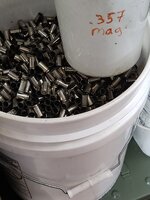
1000031564.jpg 1000031560.jpg 1000031562.jpg 1000031560.jpg 1000031561.jpg
 
My experience is that CBC brass has a step inside to best work with 115 gr bullets. trying to seat a longer bullet can be done but is not worth the extra effort. I process a lot of range brass. I only keep Speer and Winchester brass for my own use. The rest I sell to other loaders or a local brass processer. By sorting the brass by headstamp I get a uniform feel while seating bullets. Any that feel off get set aside for special handling and separate inspection. DR
 
My experience is that CBC brass has a step inside to best work with 115 gr bullets. trying to seat a longer bullet can be done but is not worth the extra effort. I process a lot of range brass. I only keep Speer and Winchester brass for my own use. The rest I sell to other loaders or a local brass processer. By sorting the brass by headstamp I get a uniform feel while seating bullets. Any that feel off get set aside for special handling and separate inspection. DR
Constant inspection.
It's like leftovers, if there is a question, there is no question.
In the scrap bucket they go.
 
My experience is that CBC brass has a step inside to best work with 115 gr bullets. trying to seat a longer bullet can be done but is not worth the extra effort. I process a lot of range brass. I only keep Speer and Winchester brass for my own use. The rest I sell to other loaders or a local brass processer. By sorting the brass by headstamp I get a uniform feel while seating bullets. Any that feel off get set aside for special handling and separate inspection.
I haven't noticed the step, only that the CBC I've encountered was harder to work in the sizing process. In future, I'm going to pass on CBC. I'll probably skip Fiocchi now that I know there are variations.

I'm selective on what I keep to reload. For one thing, I don't mix case brands when I reload, I load them in batches by manufacturer to retain the same feel for that particular batch. Lots of odds and ends go in the recycling. All Win. with the new headstamp go in the scrap, I only keep the E. Alton Illinois Win. cases. All military 9mm go in the scrap. I don't mix them, but by appearance and feel, Blazer, Speer and Federal all seem to be coming from the same source now but they are related brands and that shouldn't surprise. Ammo manufacturers will source brass from different suppliers and variations crop up from that practice.
 
I haven't noticed the step, only that the CBC I've encountered was harder to work in the sizing process. In future, I'm going to pass on CBC. I'll probably skip Fiocchi now that I know there are variations.

I'm selective on what I keep to reload. For one thing, I don't mix case brands when I reload, I load them in batches by manufacturer to retain the same feel for that particular batch. Lots of odds and ends go in the recycling. All Win. with the new headstamp go in the scrap, I only keep the E. Alton Illinois Win. cases. All military 9mm go in the scrap. I don't mix them, but by appearance and feel, Blazer, Speer and Federal all seem to be coming from the same source now but they are related brands and that shouldn't surprise. Ammo manufacturers will source brass from different suppliers and variations crop up from that practice.
I haven't loaded Blazer in decades. Just feels different. Federal for sure. Win also
RP also but I don't like the smaller rim.
I will also do Speer.
I have a fair amount of Hornady +P that I have never used before. Seems similar to RP on rim size.
Since acquiring this last large batch of FC I may only load it going forward.
 
RP also but I don't like the smaller rim.
The newer ones have the smaller rim. The last batch of RP I loaded had very few of the older ones, so I guess most of those are gone from "my" system. The ammo side of RP has changed hands a couple of times since 2000, it stands to reason that changes would've taken place. CSG (Czech firm) now owns Federal, CCI, Speer, Hevi-Shot, Remington and Fiocchi. So we might see various headstamps on cases that are basically the same actual metal case under some kind of rationalization scheme where the parent company has them all made in one place.

I swear I've seen some S&B (owned by a different Czech company) that were just like the new RP with the small rims. But there wouldn't be any surprise that any of these companies would supply another one if demand required it.

I have a fair amount of Hornady +P that I have never used before. Seems similar to RP on rim size.
Hornady sources cartridge brass from various sub contractors.

Since acquiring this last large batch of FC I may only load it going forward.
Here again, we have "old" and "new." So I kick out the few older ones I find. I like the new ones, these are the ones that are just like Blazer and Speer.

Lately I had some cases branded Midway. These were from the 1980's and I swear the lettering looked like Winchester. If you look at this stuff often enough, you kind of develop an eye for it. Sure enough, I looked it up online and that's who supplied them to Midway. But I didn't mix them!
 
We are starting to see quantities of ammo made in Turkey. Brass quality varies. Some splits on first firing (STR, Sterling). Others last longer (TRN, Turan).
 

Upcoming Events

New Classified Ads

Back Top