





Member 5605
- Messages
- 11,671
- Reactions
- 23,712
We've all been tightening up our belts around the house and there is one area in our lives that is often overlooked when it comes to money savings.
I'm running one of my final classes at LBCC and it requires a class on Energy & Sustainability and part of this class is to do an energy audit of a home, business etc.
With access to thermal imagers, watt meters and the like, the plan is to find out where your energy voids are. What's sucking you down. The process is to bring college aged kids (not seasoned adults like myself) into a position to actually think critically about money and where it's going, how to save it etc. LED lighting, doors, windows, insulation; the good stuff. Could be home or office, does not matter. Why not make a personal gain from the class I'm paying for... right?
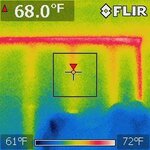
I went through the house and found out that the insulation is good via thermal camera, I had a 2* difference in wall temps from a 68* inside and a 80* exterior. That's good.
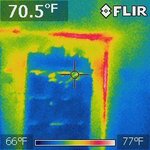
Example is this image of my NW corner of the living room. There is a few degrees difference in the corner, not noticeable to the touch in where insulation starts and stops.

This thermal makes it look like I'm oozing heat from the wall which isn't the case. Further inspection showed a 3* difference between a 65* room and a 70* south facing wall when it was 80* outside.
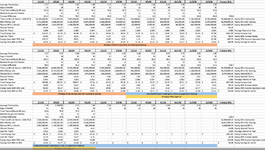
Since I run numbers at home and work, enjoy putting data into spreadsheets I compiled the data I needed for this audit of my house into an excel file.
My original thought process was to removed my inefficient furnace and replace it with a higher efficiency unit. This turns out is not going to pay off unless I'm there for 30 years. I was sure before the audit that my savings would have been greater. Turns out, mathematically I would save around $165/year for the extra efficiency. Doesn't pan out for me.

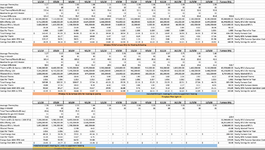
So I turned to my power consumption. While I couldn't get a real baseline number for my power rate, I did. some fudging on the numbers so the calculated rate would be similar to what I actually pay. Not hard, math guys & gals.
Looking at usage, larger power units that are on constantly is where the focus was. Right now the dryer is on, a load of laundry was just washed but those don't count as they are not things in the house that are on all the time.

Last summer I installed two mini-split systems a 36K and a 9.5K unit. I estimated a 25% duty on the larger unit and 10% on the smaller. They don't draw that much so I had to find a number that sat right with the actual power consumption during the summer months.
I think after doing this audit our home is in really good shape. I cannot find places for improvement that would actually benefit our home aside from running solar but a few years back I did that math and our average power bill now being $85/month to $120 month. Since we use an average of 900KWH at the house per year, it would not be beneficial even after tax credits. 20 years down the road if the panels lasted that long we would see a return on our investment.
How about you? Are you finding ways to tighten your household budget with power savings?
I'm running one of my final classes at LBCC and it requires a class on Energy & Sustainability and part of this class is to do an energy audit of a home, business etc.
With access to thermal imagers, watt meters and the like, the plan is to find out where your energy voids are. What's sucking you down. The process is to bring college aged kids (not seasoned adults like myself) into a position to actually think critically about money and where it's going, how to save it etc. LED lighting, doors, windows, insulation; the good stuff. Could be home or office, does not matter. Why not make a personal gain from the class I'm paying for... right?
I went through the house and found out that the insulation is good via thermal camera, I had a 2* difference in wall temps from a 68* inside and a 80* exterior. That's good.
Example is this image of my NW corner of the living room. There is a few degrees difference in the corner, not noticeable to the touch in where insulation starts and stops.
This thermal makes it look like I'm oozing heat from the wall which isn't the case. Further inspection showed a 3* difference between a 65* room and a 70* south facing wall when it was 80* outside.
Since I run numbers at home and work, enjoy putting data into spreadsheets I compiled the data I needed for this audit of my house into an excel file.
My original thought process was to removed my inefficient furnace and replace it with a higher efficiency unit. This turns out is not going to pay off unless I'm there for 30 years. I was sure before the audit that my savings would have been greater. Turns out, mathematically I would save around $165/year for the extra efficiency. Doesn't pan out for me.
So I turned to my power consumption. While I couldn't get a real baseline number for my power rate, I did. some fudging on the numbers so the calculated rate would be similar to what I actually pay. Not hard, math guys & gals.
Looking at usage, larger power units that are on constantly is where the focus was. Right now the dryer is on, a load of laundry was just washed but those don't count as they are not things in the house that are on all the time.
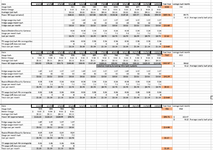
Last summer I installed two mini-split systems a 36K and a 9.5K unit. I estimated a 25% duty on the larger unit and 10% on the smaller. They don't draw that much so I had to find a number that sat right with the actual power consumption during the summer months.
I think after doing this audit our home is in really good shape. I cannot find places for improvement that would actually benefit our home aside from running solar but a few years back I did that math and our average power bill now being $85/month to $120 month. Since we use an average of 900KWH at the house per year, it would not be beneficial even after tax credits. 20 years down the road if the panels lasted that long we would see a return on our investment.
How about you? Are you finding ways to tighten your household budget with power savings?