


JavaScript is disabled
Our website requires JavaScript to function properly. For a better experience, please enable JavaScript in your browser settings before proceeding.
Messages
41
Reactions
79
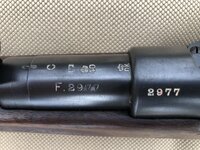
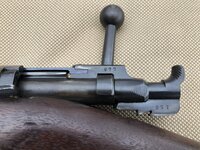
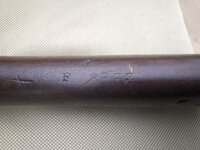
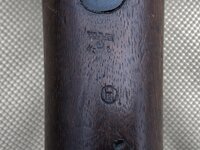
One of my favorites. This a 1890 Danish Krag that was captured by the Germans in 1940 and went through an inspection at the Army Ordnance Depot at Mainz. It is all matching and in fantastic condition. The muzzle caps are very difficult to locate, so having this one intact was a big plus. It's hard to believe this was even issued after inspection, due to the lack of wear. There would have been a small unit disc in the right side of the butt stock designating the unit to which the rifle was assigned. This was removed and filled in with a wooden plug, probably by the Germans, as this was also done on many/most Germany modified Czech Vz.24 Mauser rifles.

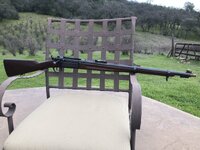
IMG_1341.jpeg IMG_1344.jpeg IMG_1347.jpeg IMG_1354.jpeg IMG_1375.jpeg
 
The crown and 40 stamped on the barrel, does that indicate it was made by the Danish in 1940? If so, that would be a very late one.

Is this rifle still in 8x58R configuration?

Is there any documentation that might indicate what German formations used this type of rifle?

Thanks.
 
1940 is the last year before capture that the rifle went in for repairs or inspection. It's still in 8X58R.

Captured foreign made weapons ('Beutewaffen') were typically assigned to second-and third-line troops and units assigned to largely uncontested duties in which the ammo allocation would have been limited. This includes training, guarding fixed installations, POW camps, and any number of non-front line, non-combat duties. Due to attrition and battlefield losses, the need for weapons for such troops (which in the Wehrmacht as in any other military) would have outnumbered those in direct combat roles.
 
Last Edited:
From my reading over the years, the German forces in WW2 rarely had enough of anything. Even major offensives were put together with resources scoured from other areas.

Wheeled vehicles were always in short supply. Never mind the German Army's reliance up to the end of the war on horse drawn livery for supply and artillery transportation. Yes, it saved on fuel. But "hay burners" do a lot of that, which takes that much more logistical effort. And of course a lot of labor for daily care of so many animals. Plus veterinary service. There are statistics online about this. It's been estimated that the German forces used approx. 2.75 million horses and mules during the war, with approx. 750,000 of those being casualties. Horses run out of steam fairly quickly when used heavily and their daily rate of march is about 20 miles.

The need for light wheeled vehicles of all sorts caused the German government to requisition (take without compensation) privately owned vehicles. Which was an easy, quick source of equipment but a nightmare for the motor pool when it came to parts and maintenance.

When requisitioned, vehicle owners were typically given a receipt that promised to return the vehicle at the end of the conflict.
 
'Unprepared' would be a kind term to use regarding Germany on the eve of Operation Barbarossa. The intelligence failures, hubris and lapses in professional judgment are as unforgivable as they are breathtaking.

There was a very real and concerning crisis that began in 1941 with rifles alone. So many were lost, destroyed and chewed up in combat operations and logistical weaknesses among the understaffed Ordnance repair units that the supply of serviceable rifles was of real concern. There are plenty of combat photos showing troops fielding Czech Vz.24 rifles at the time, as domestic German production of the K98k had been allowed to slow, with even some contracts lapsing. That's also when we see German small arms development really take off, with the G41, the G43, MG-42 and the MkB42 (forerunner to the MP-43 and StG-44) get fast-tracked in production.
 

Upcoming Events

New Classified Ads

Back Top