


JavaScript is disabled
Our website requires JavaScript to function properly. For a better experience, please enable JavaScript in your browser settings before proceeding.
Messages
9,407
Reactions
19,577
Both of my parents are from western Iowa. We used to travel back there for visits every few years. Usually staying with friends or relatives. The older ones lived in town, the younger ones tended to still live on the farm. I've visited there a few times as an adult but not lately. At my age now, nearly everyone I knew there is dead or scattered.

Lately, I've been looking at the area on Google Earth. I've been dismayed to discover that some of the farms my relatives used to live on no longer exist. Completely wiped away from the face of the earth. The land is still farmed, but not by an owner occupier. The land has been consolidated into a larger farming operation. The buildings have been razed. Google Earth has a history feature that allows a viewer to go back in time to view older images. In the case of one farm, it was there then it wasn't, just in the span of one or two years. The only remaining structure was a metal grain silo; house, barn, machine shed, all trees, gone. Another was slowly allowed to rot away and eventually was plowed under. The farm patch got smaller and smaller over the years and finally completely vanished.

I've got annotated township maps from 1977-78. And I've viewed a 1940 township map online. On both, abandoned farms are noted. The number of active occupied farms has been diminishing at least since the 1940 map. But as evidenced by the noted abandoned properties, family farms at one time were way more numerous and close together. Like "Little House on the Prairie." These days, if you get stuck out on one of those county roads, you might have a long walk back for relief. The county does NOT have full cell phone coverage; there are lots of dead spots.

This falls into the category of, "you can't go back there" in the way of examining your past. It's just gone. I'm sure the same thing applies in some rural areas of the PNW.
 
That's what a bad economy does to people. They gotta sell the farm to big biz.
Farming has never been an easy way to work for a living. The vagaries of weather and crop prices are beyond their control. The economics of it favor those who can survive a bad year and hope for a better next one. Small farms usually don't have that kind of depth. It's easier to sell up and head to the city for steady work.

Some people just aren't willing to do the hard work. Farmers get up early and go to bed late and involve themselves in a lot of labor in between. If they slack off, something dies or goes bad.

Equipment costs have gone through the roof. Small farmers just can't afford the prices. Some got into sharing deals, or borrowed from neighbors who were better off. But taking out loans on equipment that can't be repaid is one way to go out of business.
 
People vote with their dollars. The larger the place the cheaper they can sell the products they raise. The consumer wants cheaper. :s0092:
I want cheaper products. That helps offset inflation.

Edit: There are always more expensive products available for those who like to pay more for the stuff they buy.
 
Farming has never been an easy way to work for a living. The vagaries of weather and crop prices are beyond their control. The economics of it favor those who can survive a bad year and hope for a better next one. Small farms usually don't have that kind of depth. It's easier to sell up and head to the city for steady work.

Some people just aren't willing to do the hard work. Farmers get up early and go to bed late and involve themselves in a lot of labor in between. If they slack off, something dies or goes bad.

Equipment costs have gone through the roof. Small farmers just can't afford the prices. Some got into sharing deals, or borrowed from neighbors who were better off. But taking out loans on equipment that can't be repaid is one way to go out of business.
67 days straight and long days for me last summer. Its definitely not for everyone
 
My grandpa was a farmer in Mississippi way back when. He would lease dirt just like everyone did and gave a share of the harvest to the church. He used a pair of mules to plow the ground.
From what I heard from family members throughout the years was that he worked himself to an early grave at 55 yo. RIP grandpa Ike. :(
 
My dad was working for his father when he left the farm in 1941 to go build airplanes. My grandfather didn't have a tractor; he was still farming with horses. That was one of my dad's repeat phrases about that turn in his life. Which was, "I didn't want to spend the rest of my life looking at the back end of a horse." They were on a rented farm, didn't know from year to year how much longer they were going to be there. They rented from a relative; eventually, that family decided they wanted to sell and my grandparents had to leave.

The Depression didn't magically end at the same time all over the country. The economies in cities picked up before it happened in rural areas. There were rural areas that were still depressed to some degree into the war years.

When my grandparents had to leave the farm, they moved to the city. My grandfather got war work right away and made more money in a single year than he'd made in many, many previous years combined as a farmer. When my dad wasn't working for his dad, he hired out as a hand to other farmers. Who paid about one dollar a day in 1940. Working in the city building aircraft, he made well over a dollar an HOUR. Over ten times he'd made as a hired hand in Iowa.

Largely forgotten today is that there were actually two Depressions in the 1930's in the US. The first one that began in late 1929, peaked in 1933, and gradually abated. BUT: There was a second Depression in mid-1937 to mid-1938. Sometimes called "the recession in the Depression," which stalled recovery until the war years.
 
Last Edited:
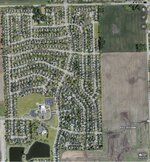
Most of the farms, that I am familiar with, started planting houses…
1776444938140.jpeg
…similar to this.
🚜💨___🏘️🏚️🏘️🏠🏘️🏡___
 
Last Edited:
Just depends on the proximity to a "wage earning area" a.k.a., a city. The county my parents are from is along the Missouri River, northeast from Omaha, Nebr. The in the western part of the county nearest Omaha where my dad came from, there have been some residential developments on formerly rural land. The suburban sprawl situation for commuting workers. But in the eastern side of the county where my mother is from, the spread has yet to occur.
 
Yep, it's happening everywhere.
I was on the very edge of a small town, bordered by hay, filberts, and Christmas trees.
These were mostly family farms, but the most recent generations of inheritants have no interest in farming, and selling of these huge acreages will give them more instant money than they ever would have made with their crops. They are now huge sub-divisions.
Another issue fueling all this, is our small town is big on anexation. Put an anexation bid on the ballot and folks automatically vote YES. These farms which were rural, are now within the city limits. That completely changes the complexion and operation of farms.
 
That's what a bad economy does to people. They gotta sell the farm to big biz.
Let's not get conspiratorial. Young people in general are not interested in farming as an occupation. The older generation of farmers has been selling out in favor of retirement. They sent their kids to college for "a better life" and they left the land. This has been going on for some time. Corporate farming has been taking over due to economies of scale. Add in the increasing cost of farming equipment, and it keeps getting harder to make a living on smaller acreages. The family farm has been a vanishing entity for decades. The high startup costs in land and equipment prevent the average person who might be interested in farming from entering the occupation. Only the wealthiest can consider it. It has nothing to do with good or bad short term economic conditions. It is a societal phenomenon.
 
The high startup costs in land and equipment prevent the average person who might be interested in farming from entering the occupation. Only the wealthiest can consider it. It has nothing to do with good or bad short term economic conditions. It is a societal phenomenon.
I agree with everything in your post, #16, very well explained.

In particular, the phrase, "...the average person who might be interested in farming." These are rare birds. For a long time, farming was a thing people were born into. Because it was the predominant way of life in America. But as American life shifted more to the cities, this was less and less the case. As I've said in a previous post, farming is very hard work when done successfully. Most Americans have found easier ways of making a living.

They sent their kids to college for "a better life" and they left the land
Yes, this is what most of our relatives and family friends did in Iowa. Last time I was back there 15 years ago, I asked about the son of one of my dad's youthful good pals. We stayed on their farm during visits a few times. The son was about my age; he inherited his dad's relatively big farm and stayed on it. I was told he'd died at age 54 from cancer. I was also told this was happening more and more often. The townsman I was talking to had the opinion that the cause was exposure to the many chemicals that are used in agriculture.

In another thread, I mentioned the metamorphosis of the meat packing industry in the Midwest. The unions were frozen out in the 1970's as the packing industry sought to reduce costs. Union meat packers were replaced by immigrants, mostly from Mexico. Which revitalized some dying Midwestern towns. But beyond the packing companies eliminating union labor, meat processing is another form of labor most modern (white) American workers don't want to do. Number one, it's hard, boring, dangerous work. Number two, lots of Americans who grew up seeing anthropomorphized animal cartoon characters on TV don't have the stomach to fire a bolt into the head of a steer or carve one up.
 
"Clarkson's Farm" is the best thing Amazon Prime ever put out. While not American or representing the majority of what middle-class farming is like, it does give a perspective on farming that really goes to show just how miserable, thankless, and depressing it can be. Jeremy regularly mentions how it's not so much of a gut-punch to him if something bad happens (because of his wealth and Amazon contract), but to his neighboring farmers it can break a season and sink an entire farm into irrecoverable debt.

I was briefly in FFA in Junior High as a kid. I doubt that program even exists at that school anymore.
 

Upcoming Events

New Classified Ads

Back Top