JavaScript is disabled
Our website requires JavaScript to function properly. For a better experience, please enable JavaScript in your browser settings before proceeding.
My experience with TTSX bullets tells me to start low, WAY low and work up slowly. Cooper bullets don't behave the way lead core bullets do in regards to pressure curves. Had one load with 140 grain .284 that was fine at minimum, ok a step above and overpressure in the middle of Barnes' data. I've also found H1000 to be very forgiving but I'm hesitant to experiment much with it as it's hens teeth on the shelf right now
 
I've also found H1000 to be very forgiving but I'm hesitant to experiment much with it as it's hens teeth on the shelf right now
Its been in stock at Midway for like 6 months now. I picked up 8lbs of it last summer for a new handload.

Get some while you can though.
 
Both have hollowpoints, the only difference is one has a plastic tip. I'm not certain of any other design differences.
I don't need to push max velocity but agree it makes no sense to leave velocity on the table. This is one reason why I like to start new loads with a pressure ladder, then I back off about a full grain of charge weight from the first sign of pressure as my max. I also like to know I can go at least .5 grain charge weight above the first sign of pressure..... keep in mind load development in winter can produce unsafe loads in summer if you stay near the top. I look for flatter primers and very faint ejection marks but each rifle is different. IMO you should be able to safely get at least 2900fps but Id see if you can safely get at least 3000fps, would be a nice hunting load in that caliber.

A side note for you, if this is a hunting rifle those Barnes need at least 2000fps at impact to properly mushroom so depending on the range you plan to hunt its worth more velocity.
I live in apartments and I don't really have the means to process or store any game currently, and I'm not into trophy hunting. I've hunted deer and elk when I was younger in MT, but it's been a long time. Honestly, this cartridge exceeds my needs, but the rifle was a gift from my brother. He gave me a couple hundred rounds with it, so I'll probably never 'need' to load for it in a practical sense, but I'm enjoying the process. And I gotta say, I really do like the big boom... being able to load for it is a good reason to empty the brass and it reaches way beyond my .223 loads can dream of.
 
My experience with TTSX bullets tells me to start low, WAY low and work up slowly. Cooper bullets don't behave the way lead core bullets do in regards to pressure curves. Had one load with 140 grain .284 that was fine at minimum, ok a step above and overpressure in the middle of Barnes' data. I've also found H1000 to be very forgiving but I'm hesitant to experiment much with it as it's hens teeth on the shelf right now

I got it on gunbroker with another powder order. Having the seller combine shipping was really the only thing that made me grab it at the shelf price, It's expensive stuff. I don't think I need a much as I got, but it was essentially "free shipping." Out of the 3, I might let a pound go, but I'm only gonna be pushing out about 100 rds/lb so I wanna hold on to a couple.
 
I try to find multiple sources of load data in order to look for comparisons. I put more priority on the data from the manufacturer of the gunpowder, than the bullet manufacturer or a third party. However, I have used all three and I am comfortable
starting on the low end of all. I have noticed that some published load data is more conservative than in past decades. I assume because of company lawyers and lowering legal liability.
 
Even at ~2,800fps a 7mmMag is certainly not an "under-powered" round by any means.
And with those high BC bullets it'll retain velocity further out and shoot flatter than a .308 with a 150gr bullet will.
 
My experience with TTSX bullets tells me to start low, WAY low and work up slowly. Cooper bullets don't behave the way lead core bullets do in regards to pressure curves.
This right here! I have a Barnes manual because monolithic bullets are quite a bit different in generating pressures than traditional cup n core bullets.
I've also ran into pressure signs, or reached max velocity before I maxed out the powder charge with either kind of bullet.
I wouldn't start with a minimum charge, but I'd start low and see what the rifle likes. I'd also pay particular attention to the amount of bullet jump when using a bullet like a Barnes. Too short and you'll jack up pressures.
 
Last Edited:
Many things affect velocity. Bullet material, bearing surface, weight, powder and weight, case capacity, barrel twist, bore diameter (.0005 makes a difference), barrel length, and a bunch of other things. Most powder company's use equipment and not a rifle. As each rifle will test differently. Each company's equipment will test differently. For the last 45 years the "book" has been a guideline (I've five) and as each cartridge has the potential to be a tiny bomb reloaders should approach maximum charges carefully. The minimum and up to middle will work fine, to start. But as mentioned I need not squeeze the last foot per second to achieve my goals. If I need a more foot pounds of energy I'll use a bigger rifle.
 
The X bullet was the first or nearly first generation design by Barnes I believe. It had a smooth shank/body adding more friction (less Vel) for pressure headroom.

The blue coated X bullets were Gen 1.5 trying to reduce friction.

The TSX was next or Gen2 with a shanked body (3 grooves) to reduce friction.

Once the LR game came in, the Tipped TSX or TSX came into play.

What Gen are the 'cuolits' (bullets) you are loading for? If originals, call them or start low because you'll run out of ceiling before you get near predicted book velocity for a TSX.
 
The X bullet was the first or nearly first generation design by Barnes I believe. It had a smooth shank/body adding more friction (less Vel) for pressure headroom.

The blue coated X bullets were Gen 1.5 trying to reduce friction.

The TSX was next or Gen2 with a shanked body (3 grooves) to reduce friction.

Once the LR game came in, the Tipped TSX or TSX came into play.

What Gen are the 'cuolits' (bullets) you are loading for? If originals, call them or start low because you'll run out of ceiling before you get near predicted book velocity for a TSX.
It's the first gen "x" bullet with lubed film. I have a 65gr h1000 load I haven't shot yet.
 
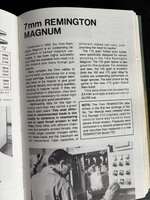
There are so many variables in handloading ammunition, that the basic rule of start low and work up is the best way to proceed. Even the "experts" who publish the manuals occasionally mess up. See the attachment from my Speer No. 10 manual, which coincidentally deals with the very cartridge the OP is dealing with.
Clearly, this proves the point that what may be safe in someone else's rifle may prove dangerous in yours.

IMG_0244.jpeg
 
There are so many variables in handloading ammunition, that the basic rule of start low and work up is the best way to proceed. Even the "experts" who publish the manuals occasionally mess up. See the attachment from my Speer No. 10 manual, which coincidentally deals with the very cartridge the OP is dealing with.
Clearly, this proves the point that what may be safe in someone else's rifle may prove dangerous in yours.

View attachment 2044089
I hadn't considered varying case capacities being a notable concern, but it makes sense.
 

Upcoming Events

New Classified Ads

Back Top