


JavaScript is disabled
Our website requires JavaScript to function properly. For a better experience, please enable JavaScript in your browser settings before proceeding.
Messages
3,218
Reactions
8,871
I know there's info about cross referencing load data already, so please excuse the redundancy.
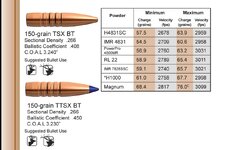
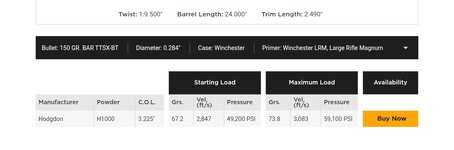
I'm looking at loading 7mm Rem mag with H1000 and 150gr barnes "x" which shares load data with the new and improved TSX. The load data from barnes also pairs it with the tipped TTSX. Looking at load data from hodgdon, their listed start load is near the max load from barnes, and barnes' start load is significantly low with velocity starting around 2758fps and max load not even reaching 3k. See pics:
Screenshot_20250124_082848.jpg

Screenshot_20250124_082931.jpg

I guess my question is; would there be a reason barnes doesn't promote their projectiles reaching those speeds, and what would you use as a start load between the 2? Under 2800fps seems a bit low for this cartridge.
 
Should I start on the lower to mid 60's for the "X" bullet since it has a lower BC and more drag? I don't want to pack too much pressure behind it.
 
Last Edited:
The Hodgdon data doesn't tell you what cases or primers were used, and it also doesn't give any pressure measurements.
Note that the Barnes data shows ~10,000psi rise for only ~250fps more velocity, that tells you that H1000 is running out of "headroom", (much more pressure for little gain).
The Barnes data also shows ~.025 less C.O.L., a deeper-seated bullet raises pressure.
Max charges almost never give the best accuracy, and trying for the last bit of velocity is seldom worth it.
I'm sure someone else will chime in with more knowledge on that cartridge than I do, I'm just pointing out some more "food for thought". lol.
 
Both options seem fine, they likely use different barrel lengths for their tests. If you're concerned than I'd say split the dif and start there. If you're not with the numbers shown than start on the low end and go from there.
You can also measure out each max listed and see how much it fills the case and if you're comfortable with that.
I've had max numbers be compress loads even without being listed as compressed, so I've pulled it back to where I was comfortable with.
 
Since you are only seeking a starting load I'd just start with a mid range load that is in whatever data you've got. It might be higher in one book and lower in the other but still "in the book(s)". I call that the benchmark load and then do my own load development to get the load I want from there.
 
Since you are only seeking a starting load I'd just start with a mid range load that is in whatever data you've got. It might be higher in one book and lower in the other but still "in the book(s)". I call that the benchmark load and then do my own load development to get the load I want from there.
I'm not sure that's scientifically proven to be the right approach, but that's exactly what I do as well.
 
Definitely start with something lower than the smallest max load and work up from there. I also error on the side of the bullet maker when working up to near a max load, as bullet construction can vary and the manufacturer may know something about their bullet not common to others.

But at the end of the day nothing beats your own empirical testing after having safely worked up to a new load. Start in the mid range and see how thing perform, checking for evidence of overpressure (on the case) or bullet deformation (on the target paper) as you increase loads. Stop when you are happy with the results or start hitting issues. It is quite possible that someone is just being overly cautious on their published data and that it can be safely exceeded (to more accepted maximums) with little downside. But you will only know that with testing.

I do concur with what others have said; it is seldom worth the compromise to squeeze out every last bit of available velocity. You will typically lose accuracy and consistency near the extreme ends of what is safe. There is no hard and fast rule for when things start to go sideways, so that will have to be empirically tested too, but I will typically stop as soon as I see the group starting to open up at all, unless I have a good reason to think I can get more velocity and accuracy from a load if I play with other variables.
 
Why? The lowest load is a safe load in all rifles that are to specifications, there is no reason to reduce it. Ah, smallest max load. Agreed.
Yep, start with something less than the smallest max load you can find in your sources. That way if there really is some limiting factor that makes the smaller max load truly limiting you can find it safely, rather than exceeding it because you went with the higher max load as your limit.
 
"It is a reported 42 degrees in Portland, but reported to be 48 degrees in Vancouver. How can I resolve this conflict?"

:)

Each is reporting what their rifle, bullet, case, primer, powder, and chronograph did when tested. Not really a conflict, just different.

Start low, work up. Don't push maximum, get a larger cartridge instead. Max under good conditions may be way over after sitting in the sun for hours when you go moose hunting near Yuma next summer.

Bruce
 
That is an odd discrepancy between published load data.
Most of my handloads have little to no load data so Im used to extrapolating starting points from similar load data. But I also run a pressure ladder as an initial test because of that. I would start at 65gn of charge weight and run a pressure ladder as follows: 65, 66, 67, 68, 69, 70, 70.5, 71, 71.5, 72, 72.5, 73, 73.5, one shot each watching for the first hint of pressure signs each shot and then you will know your max for your rifle and components. Worst case scenario you might have to pull a few bullets at the upper end of your pressure ladder depending on where you find pressure signs.
 
That is an odd discrepancy between published load data.
Really? I don't think I have any books/references that don't list different maxes, even for the same powered. I figure that is just from different ancillary factors and testing methodology, and I fully expect there to be differences because of that. In fact I assume that when the data matches it is not because of agreement in testing methodology, it is because they pulled the data from the same source.

The only time I really have questions is when the load data varies by a lot with nearly identical components. That is when I throw out the reference data and start to work it up myself from scratch like some wildcat that has no reliable data.

But the only example of that I can think of off the top of my head I know the reason for the discrepancy. I have two books that list load data for 30-06, but one of them uses the data appropriate for a Garand, while the other lists much hotter data more appropriate for a bolt action or modern semi-auto. But if you did not know that was the reason for the discrepancy I can see it causing quite a bit of confusion and concern.
 
Really? I don't think I have any books/references that don't list different maxes, even for the same powered.
To me its odd they didnt overlap more.
I dont keep track so is it common for one data to virtually begin where the other left off? I get different barrels and components but never noticed virtually no overlap.
 
To me its odd they didnt overlap more.
I dont keep track so is it common for one data to virtually begin where the other left off? I get different barrels and components but never noticed virtually no overlap.
I mean the 30-06 data basically does that from old standard limits to new. 45-70 will also do that, with old safe loads being significantly less than modern ones. If you have a gun designed for the old limits you really don't want to mix them up. It may (most likely) be safe and you will just be eating into your safety margin and beating the gun to death, but in a worst case (like an old 45-70 black powder gun getting stuffed with a modern full power smokeless load) you can have quite the kaboom on your hands.

I imagine there will be similar trends for any really old cartridge that is still in common modern use, though I have not done any kind of historical comparison to suss out how many there may be. I am sure people here can come up with other examples though.

But specific to the 7mm all I can think of is bullet limitations. Those are a thing, especially with older style bullets that cannot handle the same kinds of forces as more modern examples. 7mm does not seem like it would be old enough for that to be a problem, but it was compatible with much older 7mm bullets so I can see that being a thing that carries over, especially if one of those older bullets became a popular load for some reason.

But all that is just a guess based on other known shenanigans with other cartridges. I don't load/shoot much 7mm so I don't keep any of that information loaded up in my brain. I can't even remember how many 7mm I have floating around here off the top of my head.
 
It's too simple. The data you read in a trusted book/trusted on line source is nothing more, nothing less, than what THEIR results were with the components and test barrel/test gun THEY used. That is why it's wise to start with the lower data from these sources.
That's how I've come to look at loading data anyway.
 
It's too simple. The data you read in a trusted book/trusted on line source is nothing more, nothing less, than what THEIR results were with the components and test barrel/test gun THEY used. That is why it's wise to start with the lower data from these sources.
That's how I've come to look at loading data anyway.
200.gif
 
I was thinking that since barnes grouped TSX with TTSX load data, maybe the lower end applied more for the sake of the TSX projectiles having a hollow point and lower BC.
I would start at 65gn
I was thinking this would be a good starting point too, just in case the TSX really does max out around 67.5-68gr. It surprised me too how close barnes' max is to hodgdon's min. I was expecting to see somewhat similar data. I really have no desire or necessity to push to max, but I don't want a significantly underpowered round either.
 
I was thinking that since barnes grouped TSX with TTSX load data, maybe the lower end applied more for the sake of the TSX projectiles having a hollow point and lower BC.

I was thinking this would be a good starting point too, just in case the TSX really does max out around 67.5-68gr. It surprised me too how close barnes' max is to hodgdon's min. I was expecting to see somewhat similar data. I really have no desire or necessity to push to max, but I don't want a significantly underpowered round either.
Both have hollowpoints, the only difference is one has a plastic tip. I'm not certain of any other design differences.
I don't need to push max velocity but agree it makes no sense to leave velocity on the table. This is one reason why I like to start new loads with a pressure ladder, then I back off about a full grain of charge weight from the first sign of pressure as my max. I also like to know I can go at least .5 grain charge weight above the first sign of pressure..... keep in mind load development in winter can produce unsafe loads in summer if you stay near the top. I look for flatter primers and very faint ejection marks but each rifle is different. IMO you should be able to safely get at least 2900fps but Id see if you can safely get at least 3000fps, would be a nice hunting load in that caliber.

A side note for you, if this is a hunting rifle those Barnes need at least 2000fps at impact to properly mushroom so depending on the range you plan to hunt its worth more velocity.
 

Upcoming Events

New Classified Ads

Back Top