


JavaScript is disabled
Our website requires JavaScript to function properly. For a better experience, please enable JavaScript in your browser settings before proceeding.
Messages
37,307
Reactions
53,622
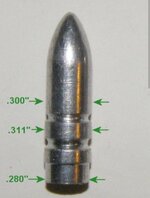
Does leading from cast bullets only come from portion of bullet that engages rifling? Or could it also come from area of bullet forward of drive bands and or gas check area if no gas check is installed?

In example example bullet, if only drive bands were powder coated would areas marked .280 and .300 contribute significantly to leading?

1000008131.jpg
 
I wouldn't say those areas would contribute SIGNIFICANTLY to leading but condition of the barrel would probably have an effect, such as the condition of the 'flats' in the barrel, if they are rough or possibly pitted.

I have always been careful about loading lead bullets to prevent leading but have experienced it a few times. A couple years ago I had some leading with some .30-30 rounds but when cleaning it the lead was mostly coming out in little rifling shaped 'striations' which indicated the lead was being mostly 'cut' by the rifling.
 
Both the sides and the base. Without a gas check the flame is actually burning a little off of the base. The friction of the bore will also wipe lead off and will cause it to stick in the lands. The rougher the bore, the worse the leading. The faster they move, the worse the leading, too.
 
I would not trust powder coating to replace the gas check. It's tougher than powder coat and is there to prevent gas cutting of the base. However as already mentioned bore condition and velocity are your primary conditions to prevent leading.
 
I experienced some leading with polymer coated cast lead in a 30-30. Worked fine with plinking loads with lower charges of unique, but as I bumped up the charge a bit, and when I tried a lighter charge of a faster rifle powder for a lighter, published load, there was some leading. I have not tried similar loads with a lead bullet W/gas check.
 
At pistol speeds most of the lead fouling is from the bullet wiping off on the sides. as pressure [ and heat] build up, some of the bullet base is burned off and left in the bore. at lower end rifle speeds a copper gas check is enough to protect the bullets base. as the pressure and velocity go up shooters had to move to paper patching the bullets to keep from scrubbing the lead off the sides of the bullets.
PC does a pretty good job of protecting bullets from scrubbing off in the bore at lower velocities. but still needs a gas check as pressure and heat go up.
If you really want to read about this look up castboolits.com. you will find more there on cast bullets lead fouling, and PC than anywhere I have found.
 
Leading mainly comes from gas cutting at the rifling and poor fit in the bore. If the drive bands seal and are coated right the forward ogive and nose riding section usually won't cause trouble. The gas check shank without a check can lead if pressures are high but in most cases it's the bands doing the real work of sealing and protecting from leading. Fit first, lube/coat second.
 
Leading mainly comes from gas cutting at the rifling and poor fit in the bore. If the drive bands seal and are coated right the forward ogive and nose riding section usually won't cause trouble. The gas check shank without a check can lead if pressures are high but in most cases it's the bands doing the real work of sealing and protecting from leading. Fit first, lube/coat second.
I've shot many thousands of plain base lead bullets in multiple calibers in pistols. In pistols as long as you stay under 1000 fps there will be no leading, even with a slightly ratty bore. In rifles lead is fine for reduced loads. If a person want's velocity stay away from lead bullets and stay with jacketed. I've about eight different molds for pistol calibers and never had much leading, if any. Remember at one time bullets were pure lead and they worked just fine until velocities started creeping up which is why gas checks and jacketed bullets were invented.
 
I've shot many thousands of plain base lead bullets in multiple calibers in pistols. In pistols as long as you stay under 1000 fps there will be no leading, even with a slightly ratty bore. In rifles lead is fine for reduced loads. If a person want's velocity stay away from lead bullets and stay with jacketed. I've about eight different molds for pistol calibers and never had much leading, if any. Remember at one time bullets were pure lead and they worked just fine until velocities started creeping up which is why gas checks and jacketed bullets were invented.
Exactly. I've found the same, handguns are forgiving as long as you don't push them, but rifles are a different animal. Once you chase velocity, you either gas check or go jacketed, period. I still run a lot of cast in reduced rifle loads, but for full power it's just not worth fighting the leading.
 
All my cast bullets end up powder coated, but I'm not looking for max velocity. Fastest I push anything is in the 1200fps in 10mm and I end up with zero leading. My 220gr 300 blk rounds are around 1050fps with no leading and the 1 round I did manage to catch didn't show any gas cutting. I'd rather have a flat base mold since powder coating a boat tail projectile leaves a mess, but I wouldn't bother going to gas checks.
 
I still run a lot of cast in reduced rifle loads, but for full power it's just not worth fighting the leading.
I've tried reduced loads in 30-06 and .308, I just don't feel the need so I stick with full power loads in all my rifle calibers. All are loaded to their original military bullet weights and velocities and that works for me. I tried lead bullets in .30 Carbine and after a bit the carbine stopped working as the gas cylinder was packed with lead residue even though there was no bore leading. So the rest of the lead bulleted cartridges were consigned to the .30 Carbine Blackhawk and nothing but jacketed in the carbines. I don't like the extra work for lead in rifles nor keeping different cartridges in different rifles. They are all sighted for the same high velocity load.
 
I wouldn't say those areas would contribute SIGNIFICANTLY to leading but condition of the barrel would probably have an effect, such as the condition of the 'flats' in the barrel, if they are rough or possibly pitted.

I have always been careful about loading lead bullets to prevent leading but have experienced it a few times. A couple years ago I had some leading with some .30-30 rounds but when cleaning it the lead was mostly coming out in little rifling shaped 'striations' which indicated the lead was being mostly 'cut' by the rifling.
The 1903 Springfield that belonged to my wife's grandfather looked pretty clean. But they only shot hand loads when her mother had it. I got all sorts of green/blue out of it when I put a couple of patches with lead and copper remover through the bore and let it sit overnight. Scrubbed it really good with a bore brush and then applied some more. Altogether 3 patches.

Now it is totally clean. I can put a patch with hopes through it and nothing showed up on the patch. After three clean, dry patches were put through. I put a little oil on another couple of patches and then followed it with one dry one. It's now sitting in the safe. Will wipe the bore again if and when I get a chance to shoot it.

I use the Tetra Gun copper and lead remover. I just used some on my M&P 15-22 as I have shot probably 500 to 600 rounds through it and only cleaned the bore with Hoppes number 9.

The ammo I'm using in it is the Aguila Super Extra that is copper plated, but very thinly plated at that.
 
Most leading starts from the base I believe. With a gas check I can shoot a bore rider like that cast from straight wheelweights with just a light tumble lube. Mostly fired at near .30-30 velocities, granted. I hate that I have to buy gas checks, but I keep a few thousand of them around as my idea was to have a good .30 cal self cast option to have in case bullets become really scarce or regulated or that kind of bubblegum.

To answer the question directly, no I don't believe the .300 and .280 portions are going to contribute significantly to leading in either case.
 
I've always had the impression that the gas check was designed to keep combustion gases from burning around the base and up the side of the bullet, not to prevent lead being burned off the base. Still learning?

Re. the question in the original post and the picture showing the .300 and .311 areas of the bullet. There are enough variables in bullet leading to suggest to me that leading might occur from both areas depending upon the circumstances.
 
I've always had the impression that the gas check was designed to keep combustion gases from burning around the base and up the side of the bullet, not to prevent lead being burned off the base. Still learning?
Those combustion gases leaking/jetting up the edges do vaporize lead and contribute to leading, particularly so as pressure increases. The gas check helps seal the base so that doesn't happen. FMJ bullets usually have a mostly open lead base, but the jacket still seals the bullet against the bore where it's needed around the circumference. That's how I've always thought of it anyway.
 
I've always had the impression that the gas check was designed to keep combustion gases from burning around the base and up the side of the bullet, not to prevent lead being burned off the base. Still learning?
The gas check does keep the gases from creeping around the bullet base and causing leading. It really has zip to do with the base itself. It covers the base as how else are you going to attach it? Remember though that's at higher velocities, plain based lead bullets generally don't lead the bore at lower velocities and gas cutting isn't a problem. A person can take a gas check bullet and load and fire it with no gas check as long as the velocity doesn't exceed the capabilities of the alloy. Another reason tin is added to the alloy.
 

Upcoming Events

New Classified Ads

Back Top