


JavaScript is disabled
Our website requires JavaScript to function properly. For a better experience, please enable JavaScript in your browser settings before proceeding.
Messages
4,361
Reactions
15,762
I have a Bullberry Contender barrel chambered in .22 Pee Wee which is very similar to .22 Spitfire/5.7MMJ/5.7Johnson, etc. I'm trying to make a chamber cast to see if the Spitfire dies will make suitable ammo for it. I've tried three times and each time I have had to melt the Cerrosafe out of the chamber as it is stuck. Really really stuck!! I've ruined three cleaning rods trying to push the casting out. I've cleaned the chamber, plugged the barrel at the leade, warmed it until it is uncomfortable to touch and melted the Cerrosafe in a casting dipper with a heat gun, poured the chamber full, waited a minute or so and tried to drive the casting out, but to no avail. I've made sure the extractor is out of the way and there is no mechanical lock. I've read a couple of instructions on the process and watched a couple of videos and don't see them doing anything differently than I am except being successful. Everything says to make sure the chamber is dry, but I'm wondering if a spot of oil might not work for mold release. We're talking less than 200 degrees so the oil should be fine. Help!!
 
I've done it with an oiled but wiped out chamber. Never a stuck problem.

Have you looked closely at the chamber to see if there might be a circular scratch from the chamber reamer?

Try waiting longer. Maybe 15-20 minutes before removal. I believe it shrinks for about 30 minutes, then expands a bit.

Bruce
 
Have you fired the rifle? If so, how does it behave upon extraction?

I would try a solid steel rod instead of a cleaning rod. You can order ground stock on McMaster Carr. It works well for a variety of things, including suppressor alignment. Pound out the casting and look for where it is hanging up. My bet is that it is, as you put it, "mechanically locked" somewhere. Possibly a poorly cut chamber.
 
Last Edited:
I have cerrosafe but have never tried using it.

If not drill rod, I'd suggest 5mm or 3/16" steel rod/hinge pin from a real hardware store.

For forced ejections, I have 1/4" dia aluminum rod and 1/4" steel all thread with super thin shrink tube on it.
Let's just say, in my reloading experiments, I've had more than a few stuck cases, some requiring judicious force.
I'll use a rubber mallet on the aluminum and a steel hammer on the all thread. I don't want to mushroom any ends.
 
If a Spitfire-sized case will fit into the Pee Wee chamber and allow the barrel to close and mate to the frame, fire-form it.

From there, only use the spitfire dies to "partlal-size" (neck and shoulder) the formed Pee Wee cases.

But I surmise you know all this. I have zero experience with cerrosafe.
 
I had a similar experience with cerrosafe sticking in the chamber and I drilled an 1/8th inch hole in the center which released just enough tension to drive it out.
 
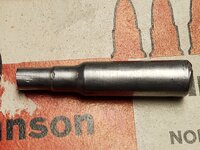
So don't believe everything you read on the 'net!! Today I oiled the chamber by putting oil on a nylon brush and giving it a couple of strokes. I only warmed the barrel to the touch, maybe 90-100 degrees. Melted and poured in the Cerrosafe, waited about 30 seconds and popped it out easily. Perfect cast of the chamber.

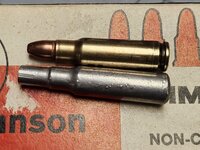
After comparing it to factory 5.7 Johnson ammo I determined that they are close enough, only a couple thou difference here and there.

I started the necking-down process with .256 Win. Mag. dies and finished with 5.7 Johnson dies and annealed the necks and shoulders.

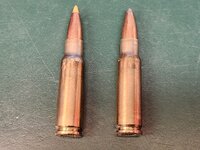
Using .22 Hornet load data as a base since they are of similar case capacity and the Hornet is fairly low pressure, I came up with 10.0gr IMR 4227 and a 50 gr. bullet, Nosler Ballistic Tips on the left and Sierras on the right. Off to the range Sunday to see how much or if they change when fire formed. Keep in mind this load is merely what I consider a safe load to test the brass forming process. The barrel is for sale in the classifieds here and think it will help the sale to have brass and a successful program for making it to go with it. Should I decide to keep the barrel much more research will be done on powders and bullet weights before serious load development commences. Maybe try the 34 gr. Dogtown bullets my .221 Fireball likes so well or go to the other extreme and try some 77 gr. bullets.
1000004650 copy.jpg
1000004651.jpg
1000004652 copy.jpg
 
So don't believe everything you read on the 'net!! Today I oiled the chamber by putting oil on a nylon brush and giving it a couple of strokes. I only warmed the barrel to the touch, maybe 90-100 degrees. Melted and poured in the Cerrosafe, waited about 30 seconds and popped it out easily. Perfect cast of the chamber.

After comparing it to factory 5.7 Johnson ammo I determined that they are close enough, only a couple thou difference here and there.

I started the necking-down process with .256 Win. Mag. dies and finished with 5.7 Johnson dies and annealed the necks and shoulders.

Using .22 Hornet load data as a base since they are of similar case capacity and the Hornet is fairly low pressure, I came up with 10.0gr IMR 4227 and a 50 gr. bullet, Nosler Ballistic Tips on the left and Sierras on the right. Off to the range Sunday to see how much or if they change when fire formed. Keep in mind this load is merely what I consider a safe load to test the brass forming process. The barrel is for sale in the classifieds here and think it will help the sale to have brass and a successful program for making it to go with it. Should I decide to keep the barrel much more research will be done on powders and bullet weights before serious load development commences. Maybe try the 34 gr. Dogtown bullets my .221 Fireball likes so well or go to the other extreme and try some 77 gr. bullets.
View attachment 2174735
View attachment 2174736
View attachment 2174737
What did you use to plug the barrel before pouring cerrosafe into the chamber?
 
As already stated, wait longer to remove the casting. Cerrosafe shrinks for 30 minutes after solidifying then begins to expand once again.

Many times, at the 30 minute mark, the casting will simply fall out of the chamber by holding the barrel pointed up and lightly tapping on a padded bench top.

Measure at one hour to have the exact dimensions of the chamber. The casting will continue expanding for 200 hours stopping at approximately 0.0025 oversized.
 

Upcoming Events

Back Top