



JavaScript is disabled
Our website requires JavaScript to function properly. For a better experience, please enable JavaScript in your browser settings before proceeding.
Messages
9,404
Reactions
19,572
Lately I was given this .45 ACP ammo. It's CCI-Speer, old packaging, very old domed primers which haven't been used for a long time. This is factory ammo, not reloaded. Which features the original "flying ashtray" hollow point bullet. I'm not sure what to make of its original package configuration. The end of the box says "25" which refers to boxed quantity. There are more than 25 arranged in the box, yet fewer than 50.; So I'm guessing that these were repackaged at some point to conserve space.

As received by me, the bullets were stacked nose first into the box, with a thin layer of dark foam packing on the bottom. As a sort of cushion, I suppose. I've seen this same foam cushion material used in the packing of some Speer bullets for reloading. Anyway, the foam in these boxes deteriorated over time in such a way that it caused corrosion and verdigris on the bullet noses. I won't say that it's completely ruined, but it will take some work to clean it up for reuse. My inclination is to take my Hornady collet puller, pull all the bullets, clean them in phosphoric acid, neck size the cases, and reload them with new powder. 150 times, that's how many there are. I'm glad that the cartridges weren't stacked in there with the primers down.


P1010974.JPG P1010975.JPG
 
Glad to find another old soul. I haven't heard anyone refer to the "flying ashtrays" since Charles Askins and Skeeter Skelton died.

That ammo would probably still shoot just fine but why chance it? Reloading the cases and bullets is the safest thing to do. Just check the case mouths carefully for splits after you load it and again before you shoot it. I have seen old cases with verdigris begin to neck split just sitting in the box. Not sure I would even pick the cases up off the ground to reload them - just maybe to discard them.
 
Had the same situation several years back just did as oremike stated and cleaned with scotch Brite pad. I believe that originally there was a plastic card with 25 holes in it for the rounds to slide through that rested on a ledge at the top of the box and then they touch down on the foam.
 
I have some 380ACP ammo from a box like that. The foam degraded to the point it was sticky and gooey. I cleaned the gunk off and shot some. Worked just fine. It wasn't stored improperly, it was just a victim of the foam padding.
 
Last Edited:
the foam in two of my rifle cases and a pistol safe disintegrated something like you have going on here, it didn't get sticky or anything, just went away????
 
I loaded and fired thousands of the "flying ashtrays" ... they were accurate and flawless in my Combat Commander. I still have about 30, I'm hanging on to them for nostalgia purposes.
 
Lately I was given this .45 ACP ammo. It's CCI-Speer, old packaging, very old domed primers which haven't been used for a long time. This is factory ammo, not reloaded. Which features the original "flying ashtray" hollow point bullet. I'm not sure what to make of its original package configuration. The end of the box says "25" which refers to boxed quantity. There are more than 25 arranged in the box, yet fewer than 50.; So I'm guessing that these were repackaged at some point to conserve space.

As received by me, the bullets were stacked nose first into the box, with a thin layer of dark foam packing on the bottom. As a sort of cushion, I suppose. I've seen this same foam cushion material used in the packing of some Speer bullets for reloading. Anyway, the foam in these boxes deteriorated over time in such a way that it caused corrosion and verdigris on the bullet noses. I won't say that it's completely ruined, but it will take some work to clean it up for reuse. My inclination is to take my Hornady collet puller, pull all the bullets, clean them in phosphoric acid, neck size the cases, and reload them with new powder. 150 times, that's how many there are. I'm glad that the cartridges weren't stacked in there with the primers down.

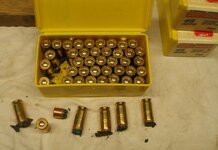


View attachment 1990723View attachment 1990724
I have CCI primers older than that and they are flat. I would email a pic to Speer and ask what's up.
 
Throw them in a vibratory tumbler with some walnut media and let them run for about two/four hours or so. They will polish right up. (I've done this many times with ugly looking ammo).
 
My solution today was to chuck them in a DeWalt cordless drill and turn the bullets in a copper (plated) Scrub Buddy pad. It took me about a half hour to do 90 pieces. They came out better than I expected.

I have CCI primers older than that and they are flat. I would email a pic to Speer and ask what's up.
The dome shape is not an anomaly. They were used for years in lots of centerfire ammunition. But I associate the use of this design with older ammo. I'm not sure, but my guess is the Lawman ammo at issue is no newer than 1970's. I associate use of domed primers before that era.
 
My solution today was to chuck them in a DeWalt cordless drill and turn the bullets in a copper (plated) Scrub Buddy pad. It took me about a half hour to do 90 pieces. They came out better than I expected.


The dome shape is not an anomaly. They were used for years in lots of centerfire ammunition. But I associate the use of this design with older ammo. I'm not sure, but my guess is the Lawman ammo at issue is no newer than 1970's. I associate use of domed primers before that era.
My guess, after three decades under the beady eyes of administrative types, is that the domed primers might have been an LE specification so that tampering (reloads) could be detected. Back in the 70s, the Seattle PD were limited to weak .38 Special rounds. A certain "fellow traveler" pulled the bullets from selected officers with an inertial puller and hotted them up. Word slipped and lots of little piles of discarded rounds were made before the next inspection.
 
My guess, after three decades under the beady eyes of administrative types, is that the domed primers might have been an LE specification so that tampering (reloads) could be detected. Back in the 70s, the Seattle PD were limited to weak .38 Special rounds. A certain "fellow traveler" pulled the bullets from selected officers with an inertial puller and hotted them up. Word slipped and lots of little piles of discarded rounds were made before the next inspection.
There were theories at one time that domed primers gave a more concentrated burn due to the concave inner surface. Which seems to have been disproven over time. There are also ideas that the curvature of a domed primer imparts added strength to the structure (think, "King Dome") which might've been a selling point with Lawman brand ammo.

If I remember, I'll go back and look to see what the military ordnance people might've thought about dome shaped primers. Some carbine ammo was made with this design primer, so it wasn't limited to large primers.

In old crap from gun shows, I've bought domed primers made for reloading. They were packed in those little wooden flats with grooves milled in them. Both WW and RP. I didn't have the concave primer seating stem, I just jammed them in with the now usual flat one and they worked fine, slightly depressed on the dome.
 

Upcoming Events

New Classified Ads

Back Top