


JavaScript is disabled
Our website requires JavaScript to function properly. For a better experience, please enable JavaScript in your browser settings before proceeding.
Messages
7
Reactions
0
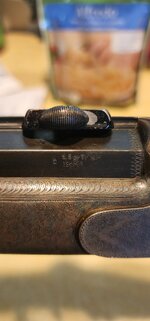
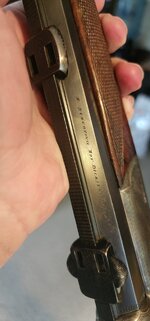
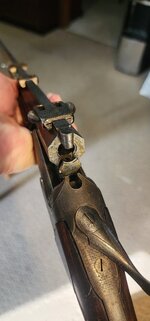
Hello all, I'm brand new to this forum. I am trying every avenue I can to identify this rifle. Back story I got from my father was when my grandfather came home from WWII, he was given this rifle by a friend of his (because grandpa was coming home first) and was told that his friend would get it from him when he came home. Apparently grandpa's friend never came home...grandpa passed many years ago and my father handed this rifle down to me. We have no information on it, no known year, caliber or anything. Its a beautiful rifle and I would love to now more about it. Please Help! Any info would be amazing! If you need more photos please let me know, it only allowed 5 photos...

5001.jpg 5002.jpg 5003.jpg 5004.jpg 5010.jpg
 
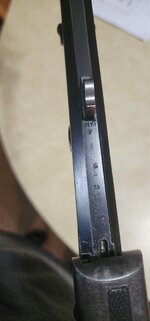
I can't be much help, other than saying it's a German Stalking Rifle. It has quick release scope mounts, do have the scope/mounts? The markings on the side of the barrel will give a clue as to caliber, as they give the bullet weight & powder charge (in grams, not grains). Additionally the markings under the barrel will give more information, but you'll need to Google German Proof Marks for more details. Hoffbuchenmacher roughly translates to Court Gunmaker, & is similar to some British guns bearing the inscription By Appointment to HRH The Prince of Wales, as an example.
 
I can't be much help, other than saying it's a German Stalking Rifle. It has quick release scope mounts, do have the scope/mounts? The markings on the side of the barrel will give a clue as to caliber, as they give the bullet weight & powder charge (in grams, not grains). Additionally the markings under the barrel will give more information, but you'll need to Google German Proof Marks for more details. Hoffbuchenmacher roughly translates to Court Gunmaker, & is similar to some British guns bearing the inscription By Appointment to HRH The Prince of Wales, as an example.
I was totally using grains not grams...great piece of info! Thank you! I'm also curious about the "SS" stamps under the barrel...possibly nazi?
 
The name on the barrel is H. Scherping who is the maker. Here is a link to a somewhat similar rifle:


Your rifle isn't necessarily the same caliber as the one shown in the link. Also different action lock work.

These are custom made rifles, made in relatively small quantities by individual guild makers. They are pretty specialized firearm items, they turn up in the US because some were brought back from Europe by GI's after WW2.

One of the Allied Military Government orders in 1945 was that all firearms including privately owned ones had to be turned in. So the piles of turned in guns that accumulated in occupied towns and cities included not just K98k rifles, but all sorts of privately owned things like this.
 
Here is a good summary article re. German sporting gun proof marks:


What I got out of it was:

The barrel underside is marked 172.28, this is the bore gauge number, the size (at the lands) and is equivalent to around .310 inch. Which would make it some kind of an 8mm. But to find out the actual cartridge size, you'd probably need to make a chamber casting.

The same area on the barrel shows another set of numbers, 1237. Which is likely the date it was made, Dec. 1937.

Scherpings were custom made guns so catalogs weren't published. But I used to have a pre-WW2 commercial Mauser catalog that showed the various models. There were a bunch of different European cartridge offerings in that which are "weird" in the US market. You can see in your picture that shows the breech/chamber area, it takes a rimmed cartridge. It could be something relatively "common" like what we call a 8x57JR. The JR takes a .318 diameter bullet, which would correspond to a .310 land size.

Before you pull a trigger, do you own research, I could be in error about any of this.
 
The name on the barrel is H. Scherping who is the maker. Here is a link to a somewhat similar rifle:


Your rifle isn't necessarily the same caliber as the one shown in the link. Also different action lock work.

These are custom made rifles, made in relatively small quantities by individual guild makers. They are pretty specialized firearm items, they turn up in the US because some were brought back from Europe by GI's after WW2.

One of the Allied Military Government orders in 1945 was that all firearms including privately owned ones had to be turned in. So the piles of turned in guns that accumulated in occupied towns and cities included not just K98k rifles, but all sorts of privately owned things like this.

Here is a good summary article re. German sporting gun proof marks:


What I got out of it was:

The barrel underside is marked 172.28, this is the bore gauge number, the size (at the lands) and is equivalent to around .310 inch. Which would make it some kind of an 8mm. But to find out the actual cartridge size, you'd probably need to make a chamber casting.

The same area on the barrel shows another set of numbers, 1237. Which is likely the date it was made, Dec. 1937.

Scherpings were custom made guns so catalogs weren't published. But I used to have a pre-WW2 commercial Mauser catalog that showed the various models. There were a bunch of different European cartridge offerings in that which are "weird" in the US market. You can see in your picture that shows the breech/chamber area, it takes a rimmed cartridge. It could be something relatively "common" like what we call a 8x57JR. The JR takes a .318 diameter bullet, which would correspond to a .310 land size.

Before you pull a trigger, do you own research, I could be in error about any of this.
Thank you for the information! I'm not sure if I ever get to pull the trigger on this one but I would live to know its history...I've never seen a dual trigger rifle one to cock it and one to fire it...its such an interesting piece.
 
There were two basic German "8mm" bottleneck cartridges. It started out as a .318 groove diameter, which is now referred to "J bore." Actually, the old German script capital "I" looks like a "J" so it came to be called J bore. I think the "I" stood for Infantrie. In the 1890's, the 8mm military cartridge was updated and standardized to a .323 groove diameter. This was called the "S" bore, I think that stands for "Spitzer" which means a pointed bullet. BUT: As I understand it, many commercial, sporting rifles chambered in 8mm in Germany continued to be J bore, or .318 groove. Then there were the rimmed versions made for single shots, double rifles, drillings, etc.

Similar developments with respect to military cartridges took place in America, too, with the 1903 and 1906 versions of .30. And later in Austria and Hungary, when they both updated from 8x50R to 8x56R.

If I have any area of expertise, it isn't with German sporting arms. Because I'm more interested in the military side. BUT: I find those pre-war German sporting rifles fascinating. Not only do they reflect a high level of craftsmanship, but the variety found is vast because of the custom nature of their production.

There is a fairly well-known anecdote about Krieghoff drillings that were issued to the German Air Force in WW2, look it up.
 
if you can find proper ammo those rifles were made to be shot. Do a little digging, maybe have a chamber cast done. From that you can verify the right ammo. once you get it right you may need to reload to keep it shooting. Good Luck DR
 
There were two basic German "8mm" bottleneck cartridges. It started out as a .318 groove diameter, which is now referred to "J bore." Actually, the old German script capital "I" looks like a "J" so it came to be called J bore. I think the "I" stood for Infantrie. In the 1890's, the 8mm military cartridge was updated and standardized to a .323 groove diameter. This was called the "S" bore, I think that stands for "Spitzer" which means a pointed bullet. BUT: As I understand it, many commercial, sporting rifles chambered in 8mm in Germany continued to be J bore, or .318 groove. Then there were the rimmed versions made for single shots, double rifles, drillings, etc.

Similar developments with respect to military cartridges took place in America, too, with the 1903 and 1906 versions of .30. And later in Austria and Hungary, when they both updated from 8x50R to 8x56R.

If I have any area of expertise, it isn't with German sporting arms. Because I'm more interested in the military side. BUT: I find those pre-war German sporting rifles fascinating. Not only do they reflect a high level of craftsmanship, but the variety found is vast because of the custom nature of their production.

There is a fairly well-known anecdote about Krieghoff drillings that were issued to the German Air Force in WW2, look it up.
Thank you, I will have to do some reading on Krieghoff...
 
There were two basic German "8mm" bottleneck cartridges. It started out as a .318 groove diameter, which is now referred to "J bore." Actually, the old German script capital "I" looks like a "J" so it came to be called J bore. I think the "I" stood for Infantrie. In the 1890's, the 8mm military cartridge was updated and standardized to a .323 groove diameter. This was called the "S" bore, I think that stands for "Spitzer" which means a pointed bullet. BUT: As I understand it, many commercial, sporting rifles chambered in 8mm in Germany continued to be J bore, or .318 groove. Then there were the rimmed versions made for single shots, double rifles, drillings, etc.

Similar developments with respect to military cartridges took place in America, too, with the 1903 and 1906 versions of .30. And later in Austria and Hungary, when they both updated from 8x50R to 8x56R.

If I have any area of expertise, it isn't with German sporting arms. Because I'm more interested in the military side. BUT: I find those pre-war German sporting rifles fascinating. Not only do they reflect a high level of craftsmanship, but the variety found is vast because of the custom nature of their production.

There is a fairly well-known anecdote about Krieghoff drillings that were issued to the German Air Force in WW2, look it up.
Since this gun was "aquired" during WWII, in regards to the SS stamps...Do you think this gun was possibly seized by the Nazi's and stamped with the SS?
 
My best guess: Likely not a marking related to the Schutzstaffel Nazi organization. Custom German gunmakers like Scherping did not necessarily make all their own gun barrels. More likely the SS on this gun refers to barrel maker Stephan Schilling of Suhl, Thuringen, Germany.

It can be confusing. Krupp supplied the steel, Schilling made the barrel, Scherping assembled the rifle. Everybody gets credit. Those names were all respected, to the maker would want those ID's on the final product.
 

Upcoming Events

New Classified Ads

Back Top